
Getting to Know Prediction Markets: Best Sites and How to Get Started
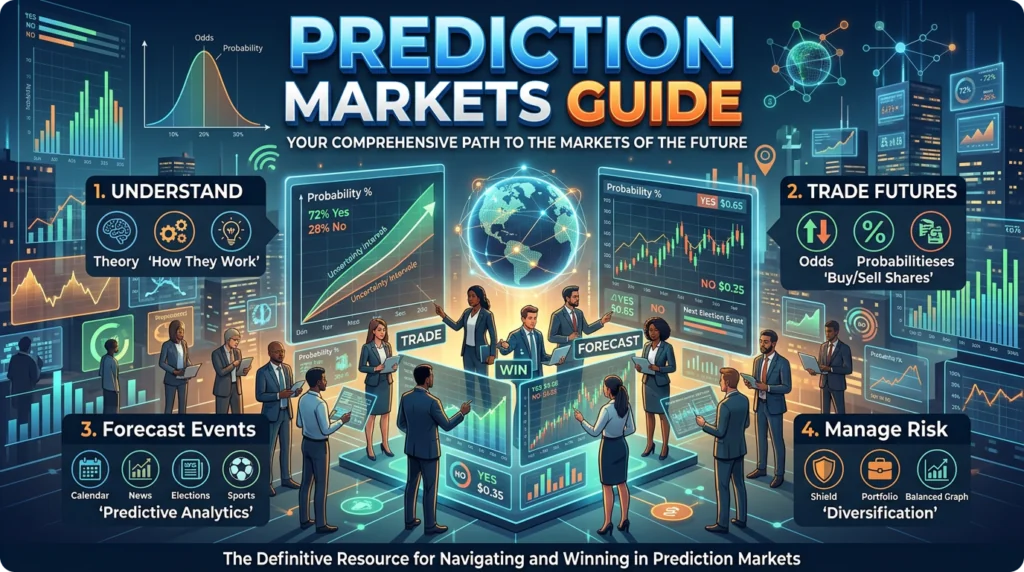
Prediction markets allow you to earn money by guessing future results. You can place bets on sports events, election outcomes, inflation rates, and a bunch of other stuff. We’ll explain how these markets operate and why they’re trending right now. You can discover the most popular prediction websites that touch on sports, politics, economics, and entertainment. This review takes a close look at the main pros and cons and highlights how it compares to typical online sportsbooks.
Grasping Prediction Markets
Prediction markets allow you to wager on the outcomes of future events. In these situations, you can buy or sell stocks. The price of a share connects to something that happens in the real world.
How Contracts Work
Each contract revolves around a simple ‘yes’ or ‘no’ query. For example, will inflation exceed a certain figure, will a particular team take the win in a game, or will a cryptocurrency hit its target price this year? The contract gives you $1 when the event takes place. You get nothing if the event doesn’t take place. Each contract typically ranges in market price from $0 to $1. This price reflects what everyone thinks about the likelihood of the event happening. A contract price of $0.65 indicates that the market believes there’s a 65% chance of the event happening. You can buy it if you’re on board. Since the final outcome is either $0 or $1, you can easily tell how much you might gain or lose. You can discover a multitude of event contracts every week in areas such as politics, sports, cryptocurrency, economic trends, and health stats.
A Simple Breakdown for Gamblers
When you place a bet with a regular bookie, you’re really going head-to-head with the house itself. The house either gives you your winnings or keeps the cash you staked. Prediction markets run using a different approach. You swap results right with others, similar to how stocks get traded on an exchange. The apps are just exchanges. They link one person’s role to someone else’s and gather a small fee. This is why you’ll want a site with plenty of money and a lot of engaged users.
Three Key Moves in Outcome Trading
People typically take three essential steps with event contracts. First, you can grab a “Yes” contract. You do this when you believe a certain result is about to happen. For instance, a basketball team’s odds of winning are set at $0.54. Since you believe they will come out on top, you decide to buy a “Yes” contract at that price. Second, you can get a “No” contract. This option is meant for situations when you think something won’t happen. An option displays a “Yes” for 49 cents and a “No” for 58 cents. If you think the team is going to lose, you can grab the “No” contract for $0.58. Another choice is to sell your contract early to lock in a profit. Imagine you picked up a “Yes” contract at $0.40. Before the event kicks off, its price jumps to $0.65. You can sell it right away and make a quick $0.25 profit, skipping the wait for the final result.
How Prediction Markets Work
To grasp how these markets operate, imagine a situation that occurs in everyday life. A large tournament final still has five teams remaining. Team A and Team B have a ‘yes’ price set at 14 cents, while their ‘no’ price is 87 cents. Team C sits at 12 dollars and 89 cents. Team D and Team E are sitting at 9 and 91 cents each. You think Team D will take the prize and you’re ready to put down $100. Here’s how to do it:
- Click the ‘Yes’ option next to Team D to open the trade ticket.
- Make sure the price reads 9 cents, then type 100 in the stake amount box.
- Check the order summary to confirm you’ll receive 1,112 contracts for your $100, which will pay out $1,112 if the team wins.
- Complete your transaction to secure the purchase.
- You can either hold on to the position until the game wraps up for the full payout or sell earlier to grab a smaller profit.
Illustrations of Prediction Markets
These markets don’t just focus on sports; political events are also a big hit. Suppose a market is curious whether a leader will sign a certain executive order this week. A “Yes” share goes for 26 cents, while a “No” share is priced at 84 cents. You have a hunch that the order’s coming, so you decide to bet $50 on “Yes”. The system verifies that you’ve bought 193 contracts for 26 cents apiece. Your accurate guess brings in a payout of $193. In the cryptocurrency space, a market might wonder whether a coin will surpass a certain price level this year. If you’re anticipating poor outcomes, you can support the “No” side to secure agreements that will pay out if the value falls short of that particular limit.
Sportsbook Odds and Prediction Market Prices
The odds set by a sportsbook show how much you could win and suggest the likelihood of a particular event happening. For instance, certain odds might show a $500 gain on a $100 bet, making your total payout $600. This means those odds suggest a 16.7% chance of that outcome happening. A prediction site shares the same information but presents it in a different way. A “Yes” price at 17 cents and “No” at 84 cents suggests that if you put in $100, you could end up seeing a return of about $589. This price suggests there’s a 17% chance that the team will succeed.
The Price Gap: Sportsbook Juice vs. Market Commissions
Sportsbooks make money from the juice, which is their edge included in the odds. A typical case is when you need to stake $110 to earn back just $100. This provides the house with a cushion of almost 5%. When it comes to sports prediction markets, the system works a bit differently. You’re up against other users’ predictions, not some set standard. These platforms operate similarly to stock exchanges and charge a tiny fee on transactions, usually ranging from 0.5% to 2%. This figure is well under what you’d usually see from sportsbooks, meaning the site profits from active trading rather than from folks making bad bets.
A Look at Different Prediction Markets

Prediction markets take on many shapes; their setups and the topics they cover vary widely.
How Prediction Markets Are Organized
There are several ways to categorize prediction markets. Their classification hinges on the model they use and the kind of currency they take for partaking in forecasts.
- Markets that deal with real currency versus those that use virtual, non-valuable tokens just for fun;
- Systems managed by a single company compared to those functioning on a distributed network like a blockchain;
- Sites designed for digital assets versus those that handle government-issued money under strict regulations.
Key Prediction Market Platforms
There are a few important services that provide prediction markets for users. Below is a look at eight notable options, detailing their functions and what they offer you.
| Service | Category | Core Details and Compliance |
|---|---|---|
| Kalshi | Regulated Service | Sanctioned election markets; covers the economy, culture, tech, sports |
| Polymarket | Decentralized | Built on blockchain networks; financial bodies provide oversight |
| DraftKings Predictions | Large Operator | Grew from an acquisition; it is live in multiple jurisdictions |
| FanDuel Predicts | Large Operator | Sports contracts are in select zones; commodities have open access |
| Fanatics Markets | Large Operator | It purchased local markets; it collaborates with crypto exchanges |
| Robinhood | Trading Service | Offers a wide variety of contracts from politics to athletics |
| Crypto.com | Crypto Exchange | Has contracts on politics, economics, sports, finance, and culture |
| PredictIt | Political Specialist | It deals with politics exclusively; no sports or other event contracts |
Popular Market Types
Predictions might focus on upcoming leaders or the weather down the line. Mostly, these prediction markets can be categorized into five different types.
Gauging Political Futures
These markets focus on the future of politics. You can support your guesses about election outcomes, a president’s popularity, or the approval of new legislation. Predict how likely a bill is to pass, if a leader might be removed, or how power may be split in government. Since individuals use their own money, the predictions often turn out to be more trustworthy compared to standard surveys. The market prices respond quickly to fresh news, giving us a real-time glimpse into political views.
Contracts on Sports Results
These betting options for sports outcomes are like your usual sportsbooks. You’ll come across options for picking game winners, point spreads, totals, and futures. For instance, guess who’ll win a tournament, snag an award, or whether a team will move on to the next round. It’s a setup where you purchase shares labeled “Yes” or “No” from others directly. Each share offers $1 for a correct guess, or nothing if it’s wrong. These are futures contracts, which means they’re regulated by financial authorities.
Economic Events and Market Predictions
These prediction markets connect closely with economic data and the finance sector. You’ll come across contracts that are tied to inflation figures, interest rate news, or commodity prices. You can try to predict how the economy will grow or whether a major stock index might hit a new peak. You might even be able to guess how many vehicles a big car manufacturer will deliver each quarter. Some people use these markets to protect themselves from risk, while others bet on economic trends without sophisticated financial tools.
Cryptocurrency Speculation Markets
Many crypto prediction markets focus on how the price of a particular coin moves over a defined period. The best sites also provide contracts for getting ETF approvals, details on upcoming network changes, and updates on tech developments. For those who hold cryptocurrency, these markets can really help balance out the ups and downs. They’re really handy for predicting outcomes, too.
Elite Prediction Groups
There are some groups packed with folks who have an impressive knack for making predictions. These folks often get outcomes right. The subjects cover everything from changes in global politics to fresh product launches and breakthroughs in science. Each forecast has a specific confidence level, which closely matches what actually occurs. Because of this, organizations gather this data to shape their policies and guide their decisions.
Contrasting Prediction Markets with Standard Sportsbooks

You’ll notice some basic differences in how a prediction market is set up and operates compared to a sports book.
Prediction Markets vs.Sportsbooks: A Closer Look
Here’s a closer look at the main differences between prediction markets and the way traditional sportsbooks work. Discover which method suits you best with this straightforward comparison.
| Feature | Prediction Markets | Licensed Sportsbooks |
|---|---|---|
| Regulation | Regulated by national financial bodies overseeing derivatives | Supervised by state gaming boards and gambling commissions |
| Availability | Generally available but faces legal challenges in certain places | Operations are limited to states or regions where they’re specifically allowed |
| Consistency | Markets offered tend to be the same across various locations | Betting options vary significantly depending on local regulations |
| Concept | You buy and sell contracts that can settle at $0 or $1 | You make fixed-odds choices where the operator determines the prices |
| Format | You engage directly with other users in the marketplace | Your competition is the operator, aka “the house” |
| Fees | A small commission, around 0.5% to 2%, applies to each transaction | The house usually keeps a profit margin of 5% or more within the odds |
| Price Transparency | Live market prices offer a clear view of the likelihood of outcomes | Probabilities are often hidden due to margins built into the odds |
| Exit Early | You can sell your contracts anytime before they settle | A cash-out option exists but might not give you good value |
| Liquidity | Market depth varies; some events attract few participants | Stays consistently high since the house takes all bets |
| Betting Limits | Bet sizes are usually small, unless in very busy markets | Big stakes are possible during major games and competitions |
| Events | Covers sports, politics, finance, and various global events | Primarily focused on sports, with a few non-sport options available |
| Live Betting | Rarely available or completely missing for in-play betting | Offers a vast array of live in-game betting options |
| Parlays and Props | Combination bets and proposition markets are quite rare | Wide range of proposition betting options and easy parlay tools |
| Accessibility | Demands some understanding of basic trading principles | Simple and user-friendly for beginners to learn |
| Best For | Analytical thinkers, traders, and those who prefer hedging | Casual users and fans who enjoy props, parlays, and live betting |
Prediction Markets: The Good and the Bad
Forecast markets offer some advantages but also come with risks. Any individual thinking about getting involved ought to be aware of these key points.
The Upsides
Prediction markets offer a unique way to bet on what might happen in the future. They possess several important features that set them apart from ordinary betting. Here are some of the main benefits.
- People tend to make sharper predictions because their own cash is at stake;
- Contract values can change instantly with each market transaction;
- Group knowledge gets utilized, rewarding accurate guesses over popular ones;
- Prices serve as clear signs and indicate the likelihood of different outcomes;
- You can offload your position before the event wraps up to manage your risk;
- The operator fees generally are lower than what sportsbooks keep;
- Topics extend beyond sports and cover political races, economic stats, and company decisions.
Possible Pitfalls
Though this market has some unique chances, it also comes with its own set of difficulties. It’s really important to grasp the possible challenges and restrictions you might face before you invest any money in these contracts.
- You might run into unpredictable rules as local governments start pushing back on certain types of contracts;
- Smaller markets can struggle with liquidity, making it hard to move big chunks of cash in or out;
- There are moral concerns about profiting from major global crises or adverse situations;
- Low-volume markets can easily be influenced by wealthy individuals looking to drive prices;
- Sports betting options are fewer, as you won’t find the prop bets and parlay selections typical at a sportsbook.
Jurisdictional Authority and Rules
Prediction markets exist within a tangled web of regulations. National finance organizations and local gaming boards both hold authority.
Legal Framework for Event Contracts
From a legal standpoint, prediction markets are seen as event contracts and are categorized under a nation’s laws regarding financial derivatives. A country’s financial committee keeps an eye on these tools. Back in the day, people mainly speculated on commodities or stocks. Now that we’re in 2026, it’s pretty common to find markets for sports outcomes and election results. This gets the green light as long as the national regulator approves it.
Government Regulation and Special Permissions
Prediction markets fall into the category of financial derivatives. This places them under the control of government bodies that monitor futures contracts. They’re not your typical speculation sites since users deal directly with one another instead of going through the house. Derivative laws usually need contracts to cover actual economic risks or help set prices. If a contract doesn’t meet this requirement, you can ask for a waiver. Officials will greenlight the request if the tool brings social or economic benefits, shows clear results, withstands interference, and safeguards market trust.
Local Authority Disputes
According to prediction sites, national financial regulations take precedence over local gambling bans. Yet, several local groups challenge this perspective. Some folks shoot out cease and desist letters. These letters label specific event contracts as unlawful sports wagers. The issue of jurisdiction continues to spark lively legal disputes in different state and federal courts.
Outlook for Prediction Markets
There’s been a significant uptick in user interest for prediction markets, and trading volumes have surged noticeably. Forecasts suggest further growth ahead. Still, legal battles will significantly shape the path of the industry. Most of the cash will likely gather at a few leading commercial sites, similar to what’s seen in online sports betting.
Important Areas for Traders to Watch
For traders looking to get an edge in prediction markets, it’s crucial to pay attention to a few significant trends. These particular factors can greatly affect how the market behaves and may offer fresh chances or pitfalls for a portfolio.
- Official government notices and court decisions that clarify legal authority;
- How available the market is and the approach different exchanges take to local legal challenges;
- The creation of new products, particularly with prop-style contracts and parlays;
- Shifts in money movement across different platforms and for specific event contracts;
- The public’s overall awareness and the role of prediction odds in media coverage;
- Periods around significant elections, as these tend to ramp up activity and draw media attention;
- New regulations for crypto assets that could change how decentralized prediction hubs operate.
Frequent Questions About Forecasting
Do Prediction Markets Count as Betting?
From a legal standpoint, prediction markets aren’t classified as gambling. The activity is about trading futures contracts, which isn’t quite the same as betting against a house. Financial regulators keep an eye on these markets, distinct from gambling commissions. The main point is simple: you can earn money by accurately guessing what’s going to happen next.
Is it legal to participate in prediction markets where I’m from?
Yes, you can find these markets allowed in many places. Their legal status hinges on the country’s financial regulations, rather than on the laws surrounding sports betting. They fall under the category of financial derivatives for each country. This classification allows them to operate in various locations, including those where online sports betting isn’t legalized.
Are Prediction Markets a Better Deal Than Sportsbooks?
Most of the time, they are. Forecast sites typically offer better value for your cash. They usually charge a small fee, ranging from 0.5% to 2% for each transaction. A sportsbook takes a bigger slice, nearly 5% on regular bets. Still, it’s wise to look around in various spots. At times, a sportsbook could offer a more favorable return on a certain outcome.
What Risks Are Found in Crypto Prediction Markets?
Crypto prediction markets present significant risks. The worth of many digital currencies can shift drastically in just a short period. There’s a discussion suggesting that knowledgeable professionals have an advantage, leaving regular traders in a difficult position. You should only spend cash you’re willing to lose, and also place stop-loss orders to protect your money from sudden market changes.
Are sports prediction markets similar to sportsbooks?
No, they actually work in a pretty different way. Prediction markets need to follow the rules set for financial derivatives. You sign contracts linked to certain results. These markets encourage transactions between individuals. A sportsbook, on the other hand, shows you odds so you can place a direct wager against the house.
How to Start with Minimal Risk?
The safest way to begin is by creating an account on a prediction site that follows strict consumer safety rules. Invest a small initial sum of cash. Give a few simple transactions a try to understand how things work. Once you’re comfortable with how the site works and what the market’s doing, you can step up your activity or dive into more complex contracts.